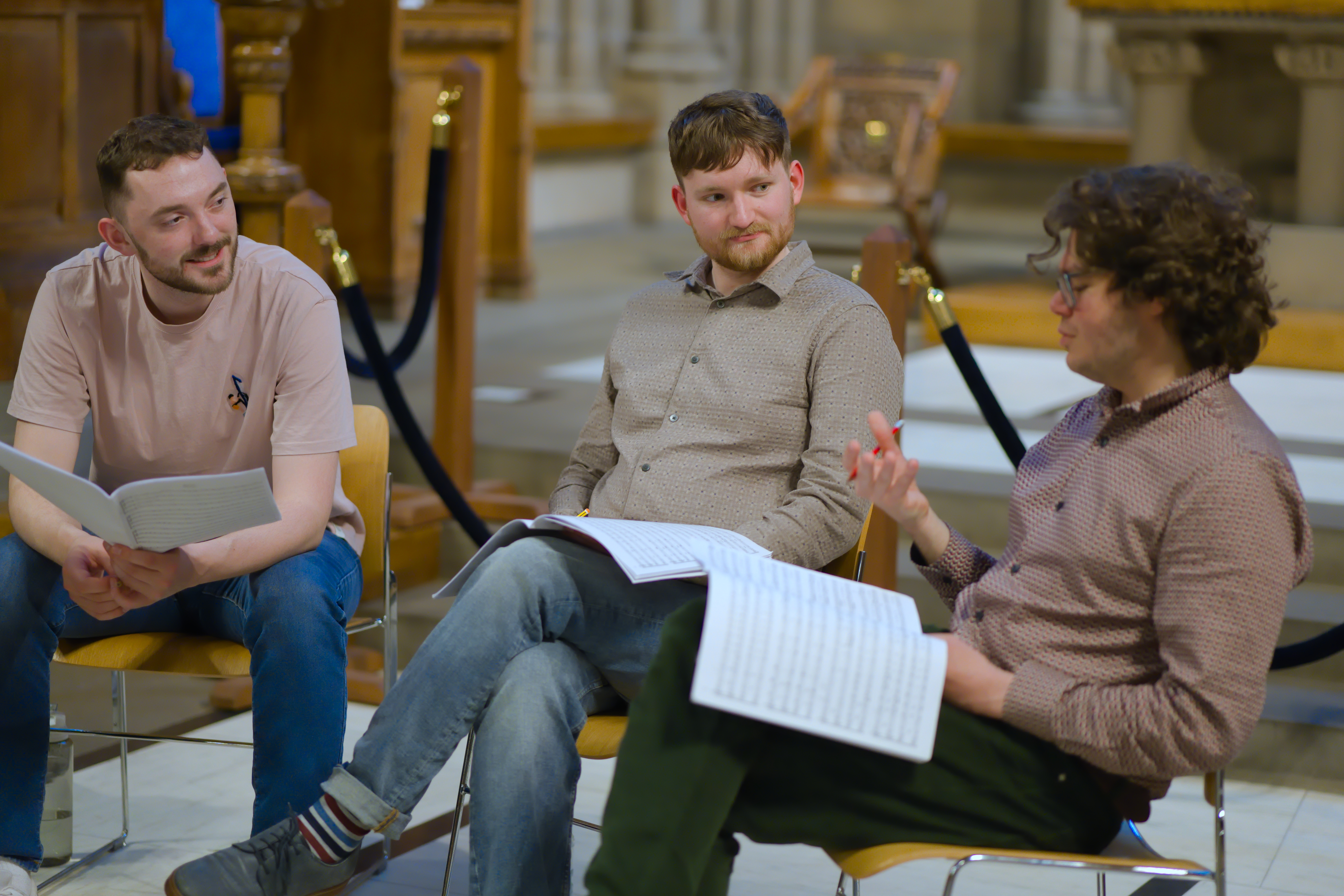
We are constantly working on new programmes, and are pleased to bring any of the following programmes to new audiences.
Polyphony for St James from the Codex Calixtinus
An atmospheric programme of various 12th-century devotional polyphony from the Codex Calixtinus, an utterly unique source from Santiago de Compostela. Some of the earliest polyphony ever notated, with striking sonorities and the distinct Moorish flavour of medieval Iberia.
Making the motet
Our programme Making the motet explores the ways in which the motet – frequently held up as one of the most important genres of vocal music – has been constructed and subsequently deconstructed through over 1000 years of music. Envisaged as part-lecture and part-recital, Making the motet takes audiences to the very moment monophony became polyphony in the medieval period, highlights the aspects that made the motet a firm favourite among musicians and audiences alike, and charts how the motet has been constantly reinterpreted up until the present day. The programme includes:
- Early plainchant
- Anonymous versus, tropes, and organa from the 12th/13th century
- The earliest Latin motets ever written
- Genre-defining Renaissance motets by composers such as Dunstaple, Binchois, and Palestrina
- Popular works by Mendelssohn and Sibelius
- Exciting modern motet reinterpretations by composers such as Eisler and Tavener
Music for Notre Dame
A programme first devised during COVID lockdown in 2020, Music for Notre Dame conjoins the ancient and the modern: Machaut’s striking Messe de Nostre Dame is paired with Poulenc’s Quatre petites prières de Saint François d’Assise. Although one may initially consider the styles polar opposites, a number of surprising parallels can be drawn between the angular and gothic counterpoint of Machaut’s famous mass on one hand, and Poulenc’s subtle yet at times alarming harmonies on the other. Within this context is placed the chant for the day, newly edited from medieval sources, as well as rarely-heard organum and 14th-century motets.
Sancte Anne matris marie
A special programme devised for a late-night concert on the eve of St Anne’s day in 2024, Sancte Anne matris marie is an hour-long programme of chant and early polyphony in Britain circa 1200. Included are all the chants for daily vespers, plus a bespoke set of extemporised polyphony and organum for the day. We would be happy to prepare programmes of a similar reflective nature for other days of the year and feasts.
Missa spiritus almus
Missa spiritus almus by Petrus de Domarto (fl. c. 1445–1455) bridges the late Medieval and Renaissance styles, combining a distinctly medieval tonality with later contrapuntal part writing. The mass is paired with soaring motets from the Trent codices by contemporaries of Domarto, including: O florens rosa by Johannes Touront (c. 1460), Ave regina by Guillaume Dufay (c. 1400–1474), and Ave maris stella by Leonel Power (c. 1370–1455). A comtemporary music theorist, Johannes Tinctoris (c. 1435–1511), used Domarto as the typical example of what to his mind was bad writing, criticising Missa spiritus almus’ popularity and Domarto’s rhythmic innovation, so much so that music historian Richard Taruskin colloquially referred to Domarto as ‘Tinctoris’ perennial whipping boy’! Despite Tinctoris’ criticisms, Missa spiritus almus is an important mass setting from the transitionary period between the Medieval and Renaissance which became hugely popular in the mid-15th century.
To your rude health!
When it comes to sacred and profane, this programme leans more to the profane end of the spectrum. Some of the most famous British composers of the 17th and 18th century wrote some of the most scurrilous songs you will ever hear! More suited to a late-night pub than a church or concert hall, To your rude health smashes preconceptions of composers such as Henry Purcell as upstanding, righteous men. The programme emerged from a research project and companion website begun in 2019. Since then, we have performed these catches, canons and drinking songs in all manner of guises: as sit-down concerts, informal pub gatherings, and even as a theatre show at the Edinburgh fringe festival!
Part of this programme is also available on CD.
Passio
A deeply devotional and reflective Lenten programme, Passio narrates the unabridged passion of Jesus through a musical recitation of John’s gospel. The narrator joins the characters Jesus, Peter, Pilate, and others as Jesus is betrayed and crucified in the exact words of the Latin vulgate. The setting comes alive by the addition of ‘turbarum voces’, or the voice of the crowd at appropriate moments in a seldom-heard setting by William Byrd. Between the chapters of the story are placed suitable motets by Byrd’s near contemporaries at the 16th-century English Chapel Royal.
This programme is also available as a live video recording and on CD.
Pérotin: the Scottish source
Our first ever programme, and the one for which the group was formed in 2018, Pérotin: the Scottish source emerged from a general sense that the ways in which 13th-century organum and discant are typically performed are far too precious, and lose their rhythmic vitality in performances that are all too slow and careful. Our programme upends this misconception by building on cutting-edge academic research to construct a completely novel performance practice using entirely new editorial practice that preserves all of the inherent rhythmic vigour and excitement. The first four-part music ever written down is performed in a manner you will never have heard before, full of life and exuberance. This programme includes:
- Much of the music that the 13th-century theorist Anonymous IV ascribed to Pérotin, e.g. Viderunt omnes, Sederunt principes, Alleluya posui adiutorium, Dum sigillum, Beata viscera
- New versions of much of the repertory based on W1, an insular source believed to have originated in St Andrews, Scotland
- The ‘Scottish responsories’ Vir iste and Vir perfecte for St Andrew, transmitted only in W1
This programme is also available on CD.
Previous posters


